
How will the new Model Context Protocol (MCP) change the way you build LLM agents?
AI models like ChatGPT are becoming more useful in real business settings — from internal chatbots to document assistants and automation tools. But even the best language model can only be as helpful as the information it's given. And that's the real challenge: company knowledge is usually spread across different systems, formats, and teams. If your AI agent doesn't have access to the right data — or gets it in the wrong format — it won't deliver the results you expect.

This is where the Model Context Protocol (MCP) comes in.
"MCP is an open protocol that standardizes how applications provide context to LLMs. Think of MCP like a USB-C port for AI applications. Just as USB-C provides a standardized way to connect your devices to various peripherals and accessories, MCP provides a standardized way to connect AI models to different data sources and tools."
— modelcontextprotocol.io
In short: MCP helps you connect your AI agent to your company's data in a clean and consistent way — without needing to retrain models, rewrite prompts, or move everything into one system.
LLM Agents Using Your Data
Most companies don't have a single source of truth. HR policies might be in SharePoint, team documents in Notion, customer records in a database, and training materials in PDFs or Google Docs.
Getting all of that into a language model today usually means:
- Manually collecting and formatting data
- Building long, messy prompts
- Or retraining the model to "understand" your content
It's time-consuming, brittle, and not very scalable. MCP takes a different approach.
Instead of forcing you to move and reformat your data, MCP helps the AI access it where it already is — and understand what it needs, when it needs it.
Whether your data comes from files, APIs, databases, or cloud storage, MCP helps organize that information and deliver it to the model in a way it can easily work with.
A Real-World Example: Building an Internal Chatbot
The Situation
You want to launch an internal chatbot that helps employees with everyday questions — about vacation policies, onboarding, tools, or IT support. Using a language model like GPT-4 sounds promising: it's flexible, conversational, and powerful.
The Problem
Your company's data is everywhere:
- HR documents in SharePoint
- IT guides in Atlassian
- Customer Data in CRMs such as SAP or Salesforce
- Team processes scattered across platforms
To make this work, your team has to constantly pull content from these systems, rewrite it, and stitch it into prompts. It's slow to build, fragile to maintain, and hard to scale.
The MCP Solution
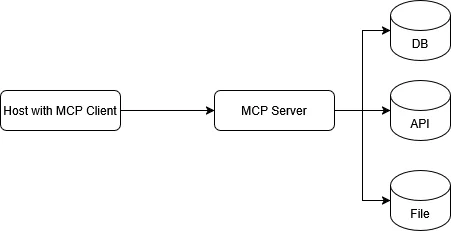
With MCP, you don't need to restructure your information or migrate anything. You simply use an MCP server to act as a translator between your systems and your AI model.
Here's how it works:
- When an employee asks a question, the MCP server fetches the most relevant info — from your original datasource.
- It packages that info into a clean, organized format for the AI.
- The AI model gets exactly what it needs to answer the question — no guesswork, no retraining.
You can add or update your sources over time, and your chatbot stays useful and accurate.
How It Works
MCP provides a structured way to "brief" your AI model before it responds — like giving it a digital folder with everything it needs.
That folder might include:
- The user's question
- Helpful background info
- Company rules or documents
- A summary of what's already been discussed
This kind of organization helps the model respond more accurately and consistently — because it always knows what it's working with. And because MCP is standardized, it works across different AI models and systems. You don't have to reinvent the wheel every time you change tools.
Why Companies Should Care
MCP is more than just a developer tool — it solves real business problems by making AI easier to deploy and more reliable to use.
🚀 Get to Value Faster
No need to rebuild your systems or train a custom model. Just connect your data and go.
🎯 Improve Answer Quality
With a well-structured context, the AI model performs better — fewer hallucinations, clearer responses.
📦 Build for Scale
As your needs grow, MCP makes it easy to add new data sources, use cases, or models without starting over.
🔓 Stay Flexible
Because it's an open protocol, MCP works across different vendors and tools — no lock-in, more freedom.
Final Thoughts
Building great AI tools doesn't have to mean reworking your entire stack. With the Model Context Protocol, you can connect your language model agents to the data your business already relies on — in a way that's fast, consistent, and scalable.
Whether you're launching a simple chatbot or planning a more advanced AI assistant, MCP helps bridge the gap between your company's knowledge and your AI's capabilities.
About the Author

Dominik Rampelt — Co-Founder of APICHAP
Dominik Rampelt is Co-Founder of APICHAP, entrepreneur, and a passionate API/back-end developer. With a focus on simplifying backend tasks and unlocking innovation, Dominik believes the right AI tools can free developers to tackle big-picture challenges—without getting bogged down in boilerplate code.